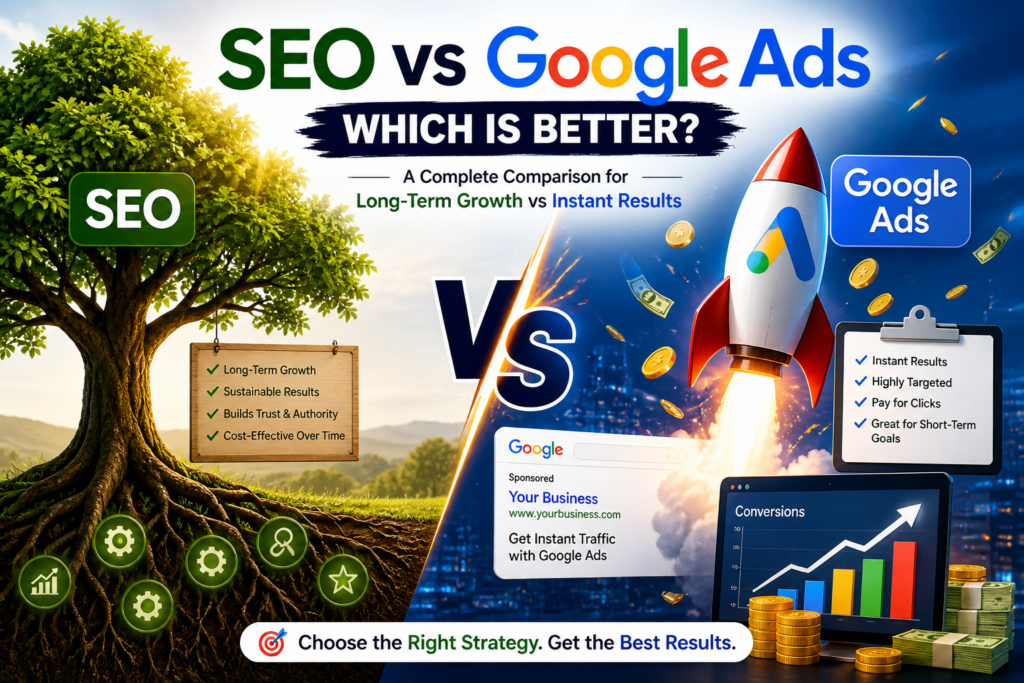
01. What Exactly Are SEO and Google Ads?
Search Engine Optimization (SEO) is the practice of structuring, writing, and technically optimizing a website so that Google ranks the pages higher in organic (unpaid) search results. The process involves keyword research, on-page content optimization, earning backlinks from other websites, improving site speed, and building topical authority over time.
Google Ads is a pay-per-click (PPC) advertising platform owned by Google. Advertisers choose keywords, write ad copy, set bids, and pay each time a user clicks the ad. Ads appear above organic results with a small “Sponsored” label. The moment the ad budget is exhausted or a campaign is paused, visibility disappears instantly.
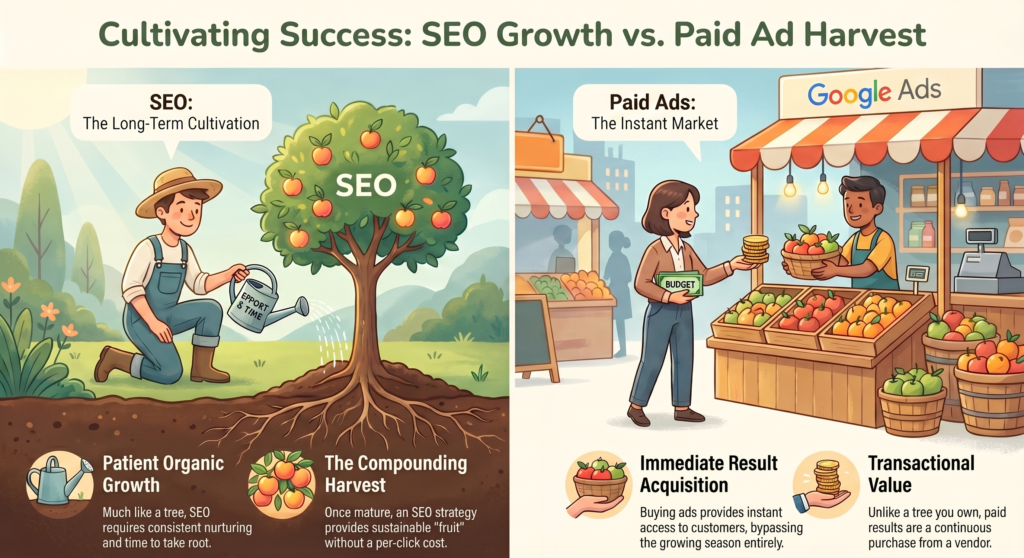
Example : Think of it this way: SEO is like planting a mango tree. You water it, nurture it, wait a few seasons—and eventually it gives you fruit for years with very little extra effort. Google Ads is like buying mangoes from the market every single day. Fresh, reliable, available immediately—but the moment you stop paying, the fruit disappears.
02. SEO vs Google Ads Cost Comparison: Where Does the Money Actually Go?
The SEO vs Google Ads cost comparison is one of the most misunderstood areas in digital marketing. SEO is often labeled “free”—which is technically accurate in the sense that Google does not charge per click. However, producing quality content, performing technical audits, building backlinks, and using SEO tools like Ahrefs or Semrush carries real financial and time costs.
Google Ads costs are transparent and immediate. Every click has a price, and competitive industries like finance, legal, or SaaS can see costs per click ranging from ₹50 to ₹500 or more. Budget discipline matters enormously—without proper targeting, ad spend drains fast with minimal returns.
| Cost Factor | SEO | Google Ads |
|---|---|---|
| Cost per click | Zero — organic clicks are free | Paid per click; varies by industry and competition |
| Setup investment | Content creation, technical audit, keyword research tools | Ad copywriting, campaign setup, landing page design |
| Ongoing monthly cost | SEO tools (₹3,000–₹15,000/mo), content writer fees | Ad budget + management fee (scales with target reach) |
| Cost after 12 months | Decreasing per-visitor cost as authority grows | Remains fixed or increases as competition rises |
| Cost if paused | Rankings hold for months without active spending | Traffic drops to zero within hours of pausing |
| Best cost scenario | Established sites with existing domain authority | Focused, time-sensitive campaigns with clear conversion goals |
03. Why the Smartest Marketers Use Both—But Strategically
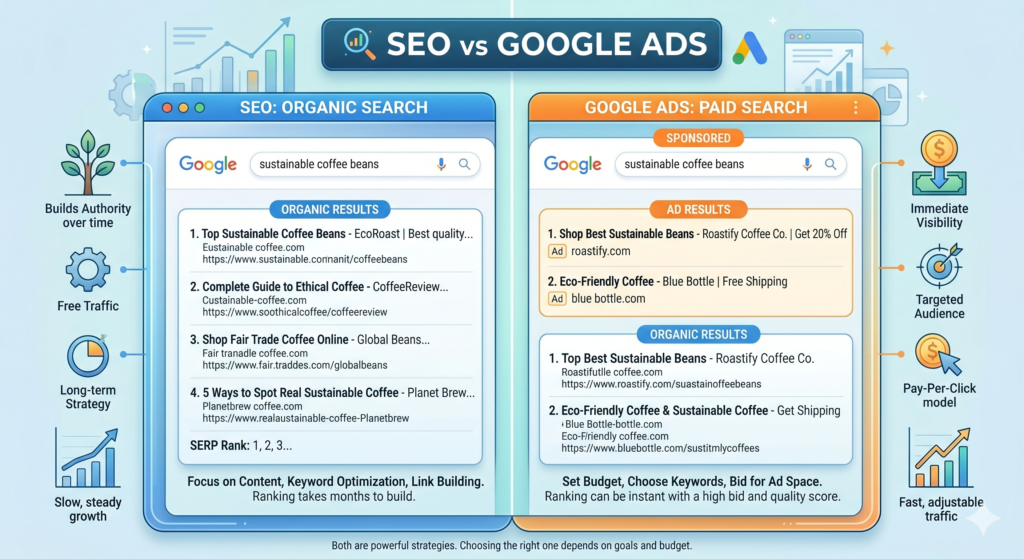
The smarter approach isn’t choosing one over the other—it’s knowing what each does best and deploying them accordingly. The SEO vs Google Ads pros and cons story becomes much more useful once you stop treating them as rivals and start seeing them as tools with different jobs.
| Factor | SEO | Google Ads |
|---|---|---|
| Purpose | Build long-term organic visibility and domain authority on search engines through content and technical optimization | Drive immediate paid traffic by bidding on keywords so your ad appears at the top of Google results instantly |
| Online / Offline | 100% online—works through your website, blog content, backlinks, and search engine algorithms | 100% online—managed through the Google Ads dashboard with real-time campaign controls and bidding strategies |
| Created by | Driven by consistent content creation, technical website optimization, and earning links from other websites | Created and managed through Google’s ad platform using keyword targeting, ad copy, and bid adjustments |
| Cost structure | No per-click fee; costs come from content creation, SEO tools, agency fees, or your own time investment | Pay-per-click model—you pay every time someone clicks your ad, regardless of whether they convert |
| Timeline to results | Slow but compounding—results typically appear in 3–12 months and grow stronger over time with little added cost | Fast—ads can go live within hours and drive traffic the same day you launch a campaign |
| When results stop | Rankings can persist for years, even after you pause active SEO work, as long as the site stays healthy | Traffic stops immediately when budget runs out or campaigns are paused—no residual benefit |
This SEO vs Google Ads ROI comparison shows why neither wins in every situation. SEO’s ROI compounds over time—one well-written article can drive traffic for years. Google Ads’ ROI is more immediate and measurable, making it ideal for product launches, sales, or seasonal campaigns.
04. SEO vs Google Ads ROI Comparison: Which Channel Delivers More?
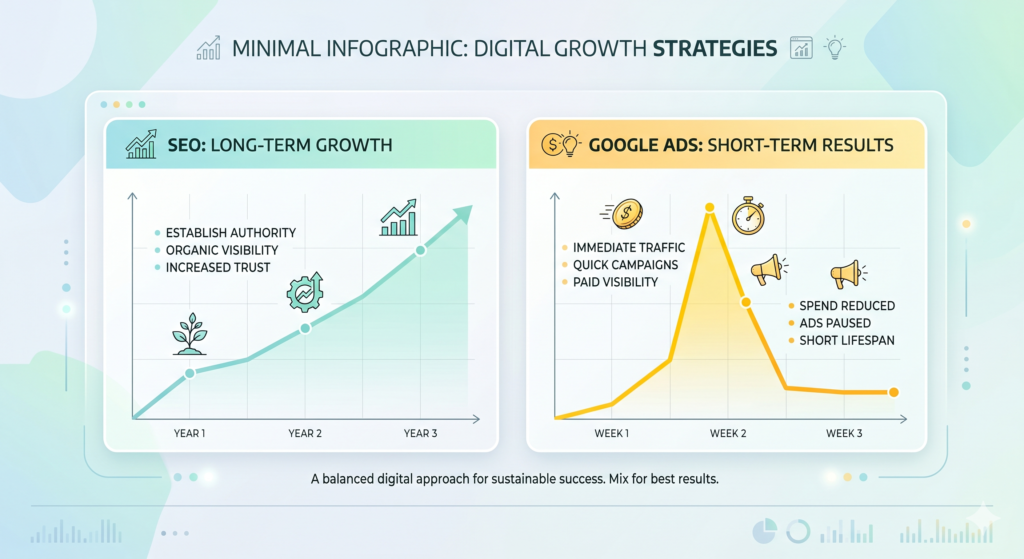
Return on investment looks very different depending on the timeframe measured. The SEO vs Google Ads ROI comparison is not a straightforward ranking—it is a time-horizon question. Within the first 30–90 days, Google Ads almost always wins on measurable ROI because SEO has not yet produced rankings. Beyond 12 months, well-executed SEO typically delivers a higher cost-per-acquisition and better margin per visitor.
| Time Period | SEO ROI | Google Ads ROI |
|---|---|---|
| Month 1–3 | Minimal — site indexing and initial rankings forming | High — immediate clicks and measurable conversions |
| Month 4–6 | Growing — early rankings begin driving consistent traffic | Stable — ROI depends on bid optimization discipline |
| Month 7–12 | Strong — compounding organic sessions lower CPA significantly | Moderate — costs often rise as competition increases |
| Year 2 onward | Exceptional — high-authority pages deliver free traffic at scale | Cost-linear — every new visitor still requires budget allocation |
For businesses that need to evaluate which is better SEO or Google Ads purely on ROI, the honest answer is: Google Ads wins short-term and SEO wins long-term. A 24-month model almost always favors SEO for cost efficiency—assuming quality execution from the start.
05. What Smart Digital Marketers Actually Do Differently
- They audit before they spend: Before choosing between SEO and Google Ads, they check their current organic ranking and conversion rate. Example: if a site already ranks on page 2, a small SEO push might outperform paid ads entirely.
-
They match the strategy to the timeline: Got a product launching next week? Google Ads makes sense. Building a brand for the next two years? SEO is the better workflow to invest in right now.
- They focus on content quality, not just keyword volume: High-ranking SEO pages solve real problems thoroughly. Example: a 2,000-word guide on “how to reduce Google Ads costs” consistently outperforms thin pages stuffed with keywords.
- They track ROI per channel separately: Mixing SEO and Ads revenue into one bucket hides which channel is actually performing. Tools like Google Analytics 4 let you see exactly which is better—SEO or Google Ads—for your specific business.
-
They don’t let fear of slow results kill good SEO strategy: Consistency beats perfection every time. Publishing one useful article per week for six months compounds into serious organic traffic—and that traffic doesn’t have a per-click price tag.
-
They set realistic timeframes for each channel: Expecting SEO results in two weeks leads to abandoning a strategy that was actually working. Smart marketers give SEO at least 90 days before evaluating performance.
06.How to Actually Get Started (Without Wasting Money)
- Define your goal first—decide whether you need traffic today (Google Ads) or sustainable visibility over the next year (SEO).
- Do basic keyword research using free tools like Google Search Console or Ubersuggest to find what your audience is actually searching.
- If starting with Google Ads, set a strict daily budget cap and test one campaign with 3–5 high-intent keywords before scaling.
- If starting with SEO, publish one detailed, genuinely useful piece of content per week targeting a specific keyword your audience uses.
- After 60 days, review your analytics—compare cost-per-result from ads versus organic growth rate, and double down on whatever is outperforming.
07. Which Is Better SEO or Google Ads? The Answer No One Wants to Hear
Asking which is better SEO or Google Ads is a bit like asking whether a hammer is better than a drill. Both are tools. Both solve real problems. Neither replaces the other across every situation.
That said, the SEO vs Google Ads which is better question does have a directional answer for most situations. Early-stage businesses with time but limited monthly budget should prioritize SEO because the compounding return eventually outpaces paid traffic economics. Businesses with cash, clear conversion funnels, and time-sensitive offers should use Google Ads to capture demand that already exists.
The most effective approach—used by high-performing digital marketing teams—is treating SEO and Google Ads as complementary rather than competitive. Ads generate immediate revenue that can fund content production. SEO data reveals which topics resonate with audiences, informing smarter ad targeting. Together, the two channels create a reinforcing loop that neither can create independently.
A Quick Decision Framework
- ✓Need traffic in the next 30 days? Google Ads is the correct channel. SEO will not deliver meaningful results that quickly regardless of execution quality.
- ✓Building a 12-month content strategy? SEO investment today creates compound returns that Google Ads can never replicate on the same budget.
- ✓Unsure which keywords convert? Run a small Google Ads test first. Real conversion data is worth far more than keyword research guesswork before committing to SEO content.
- ✓Already ranking on page 2 for key terms? A focused SEO push—improving existing pages rather than creating new content—may outperform any comparable ad spend.
- ✓Running a product with thin margins? High CPCs in Google Ads can quickly eliminate profitability. SEO’s zero-cost-per-click model protects margins better over time.
08. Frequently Asked Questions
1. Which is better for a beginner—SEO or Google Ads?
For most beginners, SEO is the better starting point because it builds long-term value without daily spending. Google Ads can produce faster results but requires budget, ongoing management, and keyword bidding knowledge to avoid waste. Starting with SEO teaches you how search engines work, what your audience searches for, and how to write content that converts—all skills that also make you better at running Google Ads later. The difference between SEO and Google Ads in terms of learning curve is real: Ads can drain your wallet fast if you don’t know what you’re doing.
2. Is the ROI from SEO really better than Google Ads in the long run?
Yes—for most businesses, the SEO vs Google Ads ROI comparison favors SEO significantly over a 12–24 month horizon. A well-optimized page can drive consistent traffic for years without any ongoing cost per click. Google Ads deliver fast, measurable ROI but that ROI resets to zero the moment your budget stops. Many businesses report that their SEO channels deliver 3–5x the return of paid channels after the first year, once organic rankings are established and compounding.
3. Can SEO and Google Ads work together, or should you pick one?
Running SEO and Google Ads together is almost always more powerful than choosing just one. Ads give you instant data on which keywords convert—data you can directly use to prioritize your SEO content. Meanwhile, SEO builds domain authority that can actually lower your Google Ads cost per click over time, because a high-quality website scores better in Google’s ad auction. Knowing when to use SEO vs Google Ads—not which is better SEO or Google Ads in isolation—is the real skill that separates good marketers from great ones.
4. How long does SEO take to show measurable results for a new website?
A new website typically begins showing measurable organic traffic growth between months 4 and 6, with significant results becoming visible around the 9–12 month mark.The timeline depends heavily on domain age, publishing frequency, content quality, and the competitiveness of target keywords. Low-competition, long-tail keywords can rank within weeks on a well-structured site. High-competition head terms in established markets may take 12–18 months of consistent effort to crack page one. Setting realistic timelines from the start prevents the most common SEO mistake: abandoning a working strategy too early because results feel slow during the compounding phase.
5. Is SEO completely free compared to Google Ads?
SEO does not charge per click, but producing quality results requires real investment in content, tools, and sometimes agency expertise.The direct cost of SEO comes through content production, keyword research platforms like Ahrefs or Semrush, technical auditing, and link-building outreach. These costs are generally lower than sustained Google Ads spend over 12 months, but calling SEO “free” creates unrealistic expectations that lead to under-investment and poor results. Framing the SEO vs Google Ads cost comparison correctly as “different cost structures” rather than “paid vs free” leads to better strategy decisions.
6. Can a complete beginner start with Google Ads without wasting money?
Yes—with proper campaign structure, tightly defined keywords, and a strict daily budget cap, beginners can run Google Ads without significant waste.The most common beginner mistake is running broad match keywords without negative keyword lists, which causes ads to appear for irrelevant searches and drain budget fast. Starting with exact match or phrase match keywords, setting a conservative daily limit, and reviewing search term reports every 48 hours prevents most costly errors. Many digital marketing students find running a small Google Ads campaign an invaluable hands-on learning experience for understanding search intent.
Final Verdict
The SEO vs Google Ads which is better debate resolves to this: Google Ads buys attention, and SEO earns it. Buying attention is fast, controllable, and expensive at scale. Earning attention is slow, compounding, and becomes dramatically cheaper over time. The businesses that win long-term do not pick a side—they deploy Google Ads while SEO matures, use ad data to sharpen organic strategy, and eventually build a search presence that no competitor can simply outspend. That combination is not a compromise. That is a competitive moat.